Most of your desks are empty. Here's what to do with the space.

Walk through almost any office on a Friday afternoon and you'll see it: rows of empty desks, monitors switched off, chairs tucked neatly under. It's easy to blame hybrid working.

But the real story is more interesting, and it's been building for years.
Across our workplace studies since 2022, average desk utilisation sits at just 42%. On a typical day, more than half the desks you pay to heat, light, clean and furnish are doing nothing at all.
That isn't a crisis. It's an opportunity, if you know what to do with the space.
Empty desks aren't a pandemic problem
Here's the part that surprises most business leaders. Long before anyone had heard of COVID, the office was already half empty.
We've been measuring desk use across UK businesses for more than a decade. Before the pandemic, average utilisation was around 50%, and in some buildings it was as low as 31%. Sales teams were out on the road, people were in meetings, colleagues were working from other sites. The desks just sat there.
Hybrid working didn't create the empty office. It made it impossible to ignore. Since 2022 the average has dropped from 50% to 42%, but the basic pattern hasn't changed in ten years: the office is rarely, if ever, full.
The hybrid week has a shape, and it's not always the one you'd expect
You've probably heard the joke: there's a name for people who only come in on Tuesdays, Wednesdays and Thursdays. Mid-week peaks are common. But when we look at how buildings are actually used, we see plenty of other patterns too.
Anchor days. A policy asks everyone in on Tuesdays and Thursdays, so those days are busy and the rest of the week is quiet.
Tsunami to tumbleweed. Salespeople and other mobile staff all come in on Monday to report on the week before. By Wednesday, the place is empty.
Flatlining. Use starts low and never rises. In one building we studied, the average was 24% and the busiest moment of the week only reached 33%.
Every business is different. The one thing these patterns share is a low average, and that means space nobody is using.
Why you can't just cut desks to match the average
If only 42% of desks are used, the obvious answer is to get rid of more than half of them. Unfortunately, it's not that simple.
In one recent study, a building with 301 work settings averaged 37% use across the week. But at 1pm on Thursday, 199 of those settings were in use, a peak of 66%. On Friday at 4pm, just 20 were. Plan for the average and Thursday becomes a scramble for seats. Plan for the peak and Friday looks like a ghost town.
That's why we always look at both numbers. The gap between the average and the peak tells you how much flexibility the space needs. And if you can bring the peak down, by spreading attendance more evenly across the week, even more of that unused space can be put to better use.
People don't come in for a desk
Ask people why they make the trip into the office and the answer is rarely "to sit at my desk". They can do that at home. They come in to see colleagues, solve problems together and feel part of something.
Our surveys bear this out. When we ask what people want to see in their future workplace:
71% want spaces for informal meetings
69% want pods or booths for Teams and phone calls
68% want collaborative and team spaces
62% want breakout and relaxation areas
There's a gap to close, too. While working in the office, 78% of people say they feel connected to their organisation and colleagues. Yet only 57% say their current office actually adds to their job satisfaction. The will to come in is there. Too often, the space lets them down.
What it looks like in practice: Manchester Airport Group
When we started working with Manchester Airport Group at Olympic House, one typical floor had 203 desks for 203 people. Average use was 40%, so on most days 122 of those desks sat empty.
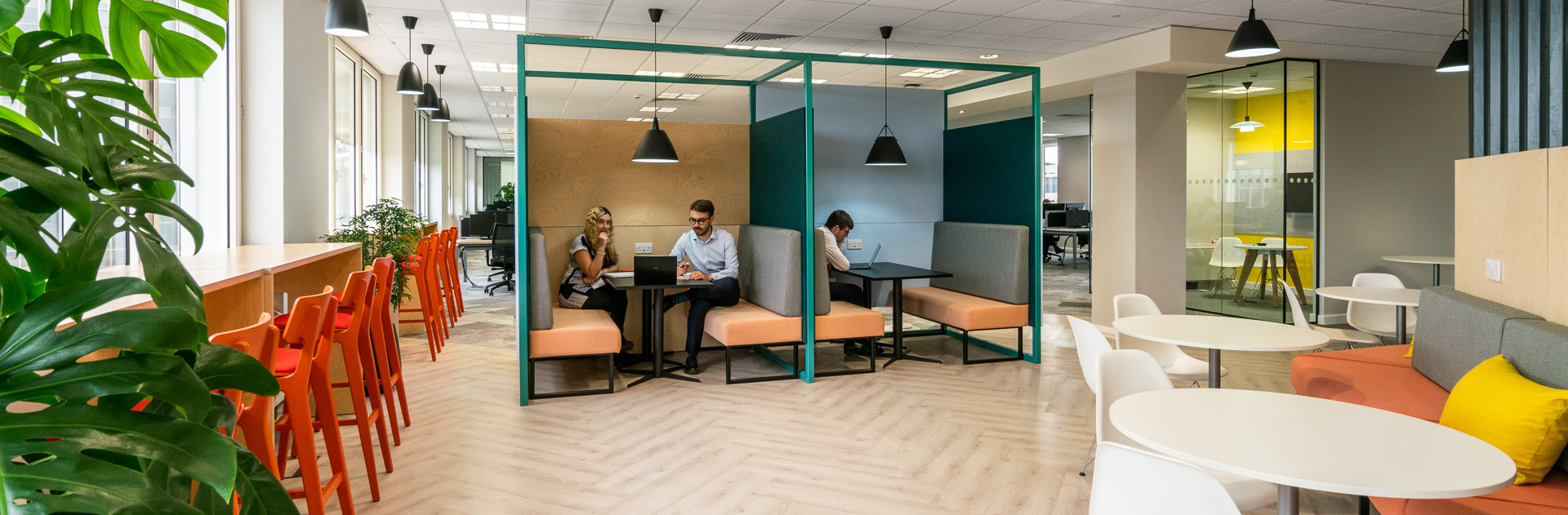
Instead of simply removing desks, we rebalanced the floor around how people actually worked:
| Before | After |
Desks | 203 | 96 |
Touchdown positions | 0 | 40 |
Other work settings | Few | Meeting, collaboration and quiet spaces |
People supported | 203 | 203 |
The same number of people, far fewer desks, and a much wider choice of places to work. The new space drew staff back into the office, improved communication and helped the project become a BCO Awards finalist in 2023. As the team at MAG put it: "We've gone through 30 years of office development in 9 months."
Three questions to ask about your own office
You don't need a full study to start thinking differently about your space. Start with these:
What is our office actually for? Focused work, collaboration, meeting clients, building culture? The answer shapes everything else.
What settings do we need, and how much space? Not just how many desks, but how many meeting rooms, call booths, team tables and quiet corners.
What does a day, a week and a month in our office really look like? Where are the peaks, where are the quiet spells, and what's driving them?
If you can't answer them with confidence, you're not alone. Most organisations can't until they look at the data.
Read the full report
The Dynamic Workplace brings together findings from 80 offices and more than 30,000 people. It covers ten years of utilisation data, how employee profiles are shifting, and case studies from Manchester Airport Group, CBRE IM and Cushman & Wakefield.


