Your office is 42% full. Why are you paying for the other 58%?

Every desk in your office costs money, whether anyone sits at it or not. Rent, rates, energy, cleaning and maintenance don’t stop when the room is empty.
So here’s an uncomfortable number. Across Squaredot’s workplace studies since 2022, average desk use is just 42%. On a typical day, more than half your desks are empty.

It’s not a new problem
Under-used offices aren’t a side effect of hybrid working. Before the pandemic, we were already seeing average desk use of around 50%, and as low as 31%. Hybrid has simply made the gap harder to ignore.
Even at its busiest, the office rarely fills up. The average peak in our post-COVID studies is 58%. In one example, desks were 66% full at Thursday lunchtime and just 6.6% full on Friday afternoon.
Look at it in hours, not desks
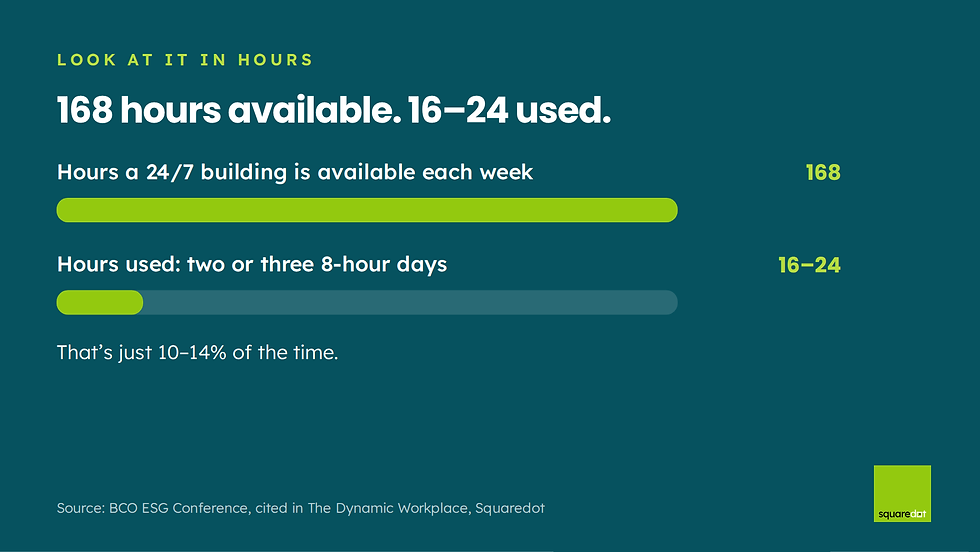
There’s another way to see it. A building that’s available 24/7 is open for 168 hours a week. If people use it for two or three eight-hour days, that’s just 16 to 24 hours, or 10 to 14% of the time.
Put like that, it’s hard not to ask whether the building could work harder.
Cut space, or make it work harder?
The obvious response is to cut space, and sometimes that’s the right call. Our recent studies have shown possible space reductions of between 29% and 46%.
But reducing space is only one option. The same data can be used to repurpose the space you already have, replacing under-used rows of desks with the settings people actually want: informal meeting areas, pods for calls, team spaces and somewhere quiet to focus.
At Cushman & Wakefield in Birmingham, the space was consolidated but gained a variety of smart new features and facilities, and the project achieved BREEAM Excellent.
Under-used space has an ESG cost too. As businesses set and evolve their own ESG targets, how well they use their buildings is becoming part of the picture.
Start with the data
Before you decide anything, measure how your space is really used: the average, the peak and the quiet days.
A government agency we worked with found that while desks took up 53% of the building, desk bookings had peaked at just 16%. With nearly half the building heavily under-used, the data made the case for change.
Then ask three questions:
What is the purpose of the office?
What settings, and how much space, do you need?
What will a day, a week and a month in the life of the office look like?
The bottom line
You don’t have to keep paying for space nobody uses. But the answer isn’t always less space. Often, it’s better space.
Find out how your space is really used
Our workplace analysis studies show exactly how your office is used across a typical week, so you can make the decision on evidence, not guesswork.
Book a call with with our design team.


