A Busy Office Isn't a Productive Office: Why Return-to-Office Mandates Miss the Point

As return-to-office mandates gather pace across the UK, many organisations are judging success by how full their offices are. Squaredot’s Creating a Productive Workplace report argues that’s the wrong measure. The real question is how well the workplace helps people do their best work.
People and property are typically the two largest costs for any business, and the two are closely linked in shaping productivity. As more UK organisations mandate time in the office, the report sets out why attendance alone won’t deliver the results leaders are looking for, and how an evidence-led approach to workplace design can.

Productivity, not presence
Interest in office utilisation is nothing new. It dates back more than 100 years to the efficiency movements of the early 20th century, and it accelerated sharply as businesses adopted hybrid working after the pandemic.
Productivity is the reason most employers want people back. According to the Cisco Global Hybrid Work Study 2025, it’s the top factor driving employers to increase office time (62%), ahead of team communication (61%) and workplace culture (54%).
But time spent in an inefficient space doesn’t automatically mean productive work. A busy office can look energetic while hiding high levels of interruption, frantic multitasking and underused space. Productive work, by contrast, means meaningful results achieved through focused effort.

What the research tells us
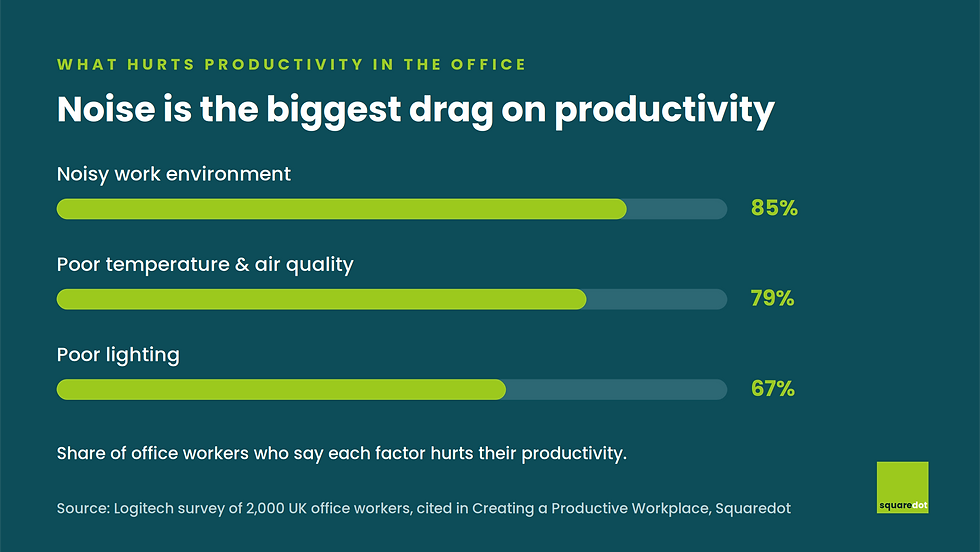
The report draws together recent research showing how much the physical environment affects output. Logitech research found that 71% of UK workers lose time to office distractions, adding up to more than 330 million hours a year, and a quarter lose an hour every week to a poor ‘productivity climate’. Among the 2,000 office workers surveyed, noise topped the list of culprits, ahead of temperature and air quality, and lighting.
The average office worker is productive for only around three hours a day, citing distractions, an inability to focus and fatigue. Engagement is low too: Gallup’s latest workplace report finds only 20% of employees are engaged at work, and just 18% of employees stay with their employer because they truly want to.
The upside is significant. Engaged employees are linked to a 78% drop in absenteeism and a 23% increase in profitability, while research from Oxford University found that happy workers are 13% more productive. Every one of the environmental problems above can be addressed through good design.

An evidence-led approach
At the heart of the report is Squaredot’s process for linking productivity with people, processes and property. It starts with an analysis of the 4Ps of workplace design: People, Process, Place and Performance. The aim is to diagnose the barriers holding a workplace back before any design decisions are made.

The process moves through workplace analysis, interviews and workshops, and observation studies, before translating those insights into strategies and, finally, workplace design. It’s built around three fundamental questions:
Who is in the office, when are they there, and what work are they doing?
Would analysis of the business and its people lead to a different approach to space allocation?
If so, what would those approaches look like in practice?
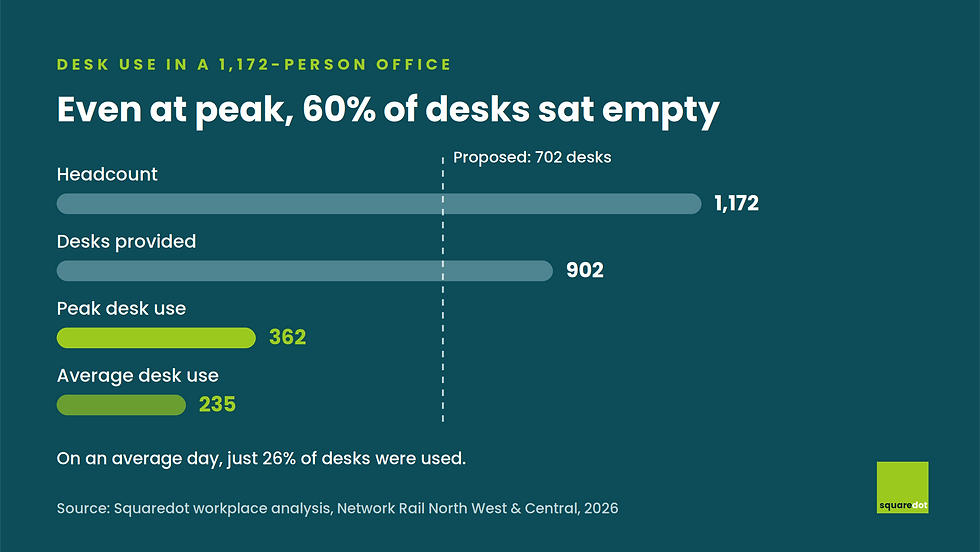
The answers often reveal a gap between perception and reality. In one recent analysis, an office of 1,172 people had far more desks than it ever used, even on its busiest day. Pilot areas can then be used to test the data before a strategy is rolled out across a whole building.
Proven results
The report includes case studies showing what this approach has delivered for Squaredot clients.
At Birmingham City Council, a portfolio of more than 50 locations was consolidated into nine buildings over seven years, providing around 7,500 workstations for approximately 9,100 staff. Absenteeism fell from 37% to 18%, and the programme won five British Council for Offices awards, including National Winner for the Test of Time Award.
For Manchester Airport Group, a workplace with 40% fewer desks now supports the same number of people in the same space, with collaborative settings replacing underused desks. Alongside an 8% rise in passenger numbers, operating profit rose 61% and the employee engagement score increased by 12.9%.
At UKRI in Swindon, where desk bookings had peaked at only 16%, Squaredot’s analysis showed the organisation could relinquish nearly a third of its building and reduce desks by 70% while remaining productive. The replanned space includes 53% more collaborative settings, and people now come in to be together rather than for a desk.
And for Network Rail North West & Central, studies across Manchester and Birmingham in early 2026 found attendance well below target and the wrong mix of settings. Reducing desks from 902 to 702 has made room for more collaborative spaces and adaptable conference rooms, cutting reliance on expensive external facilities.
A strategic asset, not just a cost
As Winston Churchill put it: “We shape our buildings; thereafter they shape us.”
Every business is different. To find out how a workplace review could change yours, get in touch with the Squaredot team.
Related reading
Office Utilisation: Why “Busy” Doesn’t Mean Productive – why a full office can hide costly inefficiencies.
How to Choose the Right Office Design Solutions – what to consider when planning a workspace around your team.
Top Commercial Interior Design Trends for 2026 – the sustainability, wellness and design shifts shaping offices this year.


