Meeting pods vs phone booths: what your hybrid office actually needs.
Meeting pods, phone booths or focus rooms? How to choose the right mix of private spaces for a hybrid office, based on what people tell us they want.
Squaredot | 2026

Walk around most offices on a busy day and you will see the same thing. Someone is on a Teams call at their desk with one hand over their ear. Someone else has taken a six-person meeting room for a ten-minute catch-up with one colleague. And somewhere, a person who needed to focus has given up and put their headphones on.
None of this is a people problem. It is a space problem. Hybrid working changed what people do when they come into the office, but many floor plans still assume the day is spent at a desk, with the occasional big meeting.
In our workplace surveys, 69% of people said they want meeting pods for Teams and phone calls. 75% want a choice of settings for different activities, and 71% want spaces for informal meetings. The demand for small, private spaces is not a nice-to-have. It is one of the clearest messages we hear.
So what should you actually put in? Here is how we think about it.
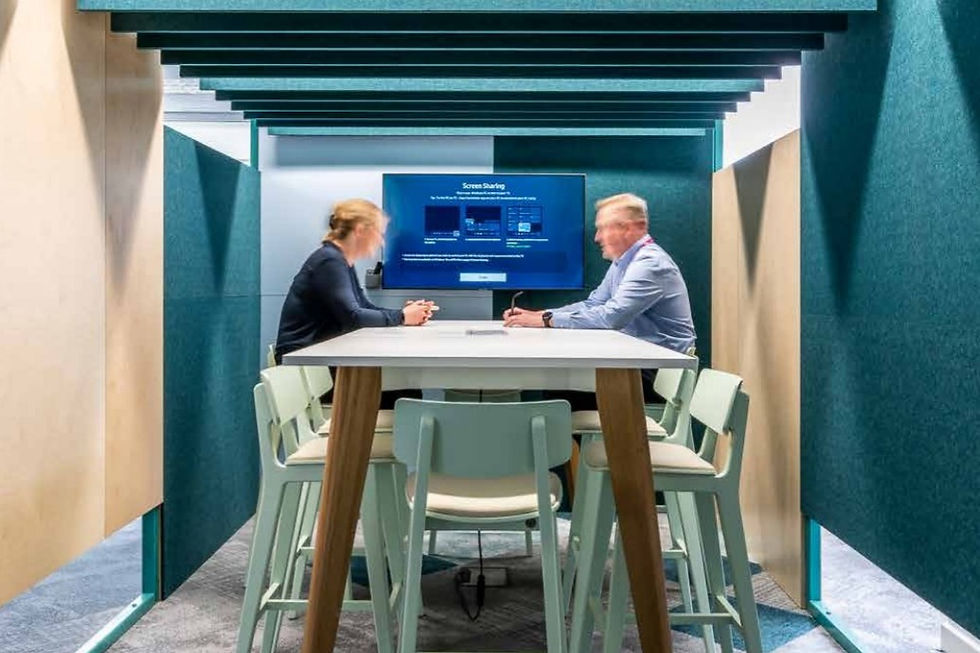
What is the difference between meeting pods and phone booths?
The terms get used loosely, so it helps to be clear.
Phone booths are for one person. They are built for calls, video meetings and short bursts of focused work. Good ones have proper acoustic panels, ventilation, a power point, a small worksurface and decent lighting for video.
Meeting pods are for two to four people. They suit quick catch-ups, one-to-ones and small hybrid meetings. They usually need a screen, a camera and a way to join a call without anyone getting their laptop out and fighting with the audio.
Focus rooms are small enclosed rooms for longer, quieter work. They can be bookable or first-come, first-served.
Most offices need a mix. The mistake is buying one type in bulk because it looked good in a showroom.
Why meeting pods have become so popular
Our co-founder Kris Krokosz put it simply on the SPOR Podcast: telephone pods are really popular at the moment. Tools like Teams mean a large share of the working day is now spent on calls, and those calls do not stop when people come into the office.
When there is nowhere suitable to take a call, two things happen. Open areas get noisier, which makes it harder for everyone else to concentrate. And larger meeting rooms get taken up by one or two people, so teams who need them for genuine collaboration cannot get in.
A well-placed set of phone booths and meeting pods takes pressure off both. It gives people somewhere to go, and it frees the rest of the floor for the work it was designed for.
How many meeting pods do you need?
There is no single ratio that works for every office, and anyone who quotes one without looking at your space is guessing. The right number depends on how your people actually work. That is why we start with evidence rather than a catalogue.
The questions we ask first are:
How much of a typical day is spent on calls or video meetings, and by which teams?
Are calls mostly one-to-one, or small groups joining a wider meeting?
Which days are busiest, and how full does the office get at its peak, not on average?
Where do people currently go to take calls, and how far is that from where they sit?
We answer them with observational studies, online surveys and conversations with the people who use the space. It is the same approach we use for any workplace project, and it is usually quicker and cheaper than people expect.
Where to put meeting pods and phone booths

Location matters as much as the number. A phone booth at the far end of the floor will sit empty while people take calls at their desks. A few principles help:
Spread them out. Put booths close to the teams who use them most, so nobody has to walk across the building for a five-minute call.
Keep them near the routes people already use. Spaces on natural walking routes get used. Spaces tucked into corners do not.
Avoid clustering every pod in one place. A wall of booths can create its own noise and queue.
Think about sightlines and privacy. Glazing is good for light and for seeing whether a pod is free, but some conversations need more privacy than a fully glazed box gives.
The meeting pod details people notice
A pod that looks great but is stuffy, echoey or awkward to join a call from will be avoided. The details that make the difference are:
Acoustics that genuinely contain sound in both directions.
Ventilation and temperature control, so the space is comfortable for more than ten minutes.
Lighting that works on camera, not just for the room.
Power and connectivity in the right places.
For meeting pods, a screen and camera set up so that joining a call is one tap, not five minutes of cables.
This is where design and technology have to be planned together. Since joining SPOR Group, we can design the space and the technology inside it as one project, so the pods work properly from the first day.
Should meeting pods be bookable?
It depends on how they are used. Phone booths usually work best on a walk-in basis, because most calls are short and spontaneous. Meeting pods for two to four people often benefit from booking, especially on peak days. Whichever you choose, make it obvious at a glance whether a space is free.
Get the mix right before you buy
Meeting pods and phone booths are one of the most effective changes you can make to a hybrid office, but only when the number, type and location are based on how your people work. Guess, and you end up with expensive furniture that nobody uses.
If you would like to see what our research says about how people use the office today, including the settings they want most, our latest report is free to download.
Planning changes to your office? Book a call with Chris and we will talk through what your space needs.


